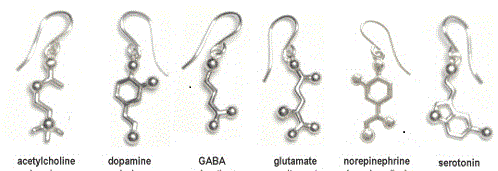
Neurotransmitter of the year 2014

An award largely forgotten after the glutamate debacle, when some restaurants decided you can’t have too much of a good thing. Serotonin may be too old for the game after half a century of tri-cyclic and SNRI usage, and quite frankly has put on an embarrassing amount of weight. Bad press due to misbehavior by lookalike pregabalin is likely to rule out GABA. AcetylCholine is a bit too vague-as to set hearts racing, but quietly achieves reduced inflammatory cytokines. Norepinephrine (common misspelling of Noradrenaline) has been fighting for sympathetic following with its edgy, flighty manner and dopamine will need more vigilance if it’s to retain the award. The thoughtful amongst you always expected this winner, but dopamine addicts can unclench your jaw and relax now. Smoko, perhaps?neuros

Besides aiding concentration, dopamine’s supporting role aka Prolactin Inhibitory Hormone breaks the pathway from leptin to inflammatory cytokine. Prolactin measures correlate with a bad prognosis in chronic Heart Failure, if the European Society of Cardiology is to be believed. Typical IL-6 levels in fibromites correspond to typical levels in New York Heart Association’s class II functionally limited. Diastolic HF in Chronic Fatigue is of concern to Miwa&Fujita, where ejection fraction is preserved but the ventricle muscle rebound is insufficient. The article in Healthcare for Women International where Leonard Jason found 20% of death certificates of CFS sufferers reported heart failure – at an age of 24 years less than the US national average will surely send chills, given the frequent syndrome coincidence of orthostatic intolerance with FM. And certainly a concern to fibromites, whose augmented prolactin response to Riedel’s or Malt & Ursin et al’s challenge test will send them to their prescribers for dopamine reuptake inhibitors (DRI). Pointless request however, they’re psycho-stimulants and perceived as likely to be abused – though you could have an opioid for pain instead! This reluctance is despite fatigue and concentration improvements from double-blind randomized clinical trials of the DRI methylphenidate for Chronic Fatigue Syndrome (Blockmans, van Houdenhove & Bobbaers or  Usón and Alecha). Pharmacotherapy solutions are actually quite a concern (doesn’t the MBBS degree cover iatrogenic issues at all?), for example amitriptyline. Despite already depleted CoQ10, fibromites are prescribed Endep which Prof Cordero has found exacerbates the problem*. CoQ10 is vital for heart muscle condition, and note that we haven’t yet considered CardioVascular Disease for which more unpleasant news was presented by Dana March of the CFInitiative this year. You’d have a coronary just thinking about it. All this risk in order to boost serotonin – neural levels of which can’t be ascertained, and serum levels don’t seem worth measuring!

Reader’s choice award for neurotranny of 2014 through your comments is eagerly awaited. But bear in mind that meddling via meds is dangerous.

*Oral treatment with amitriptyline induces coenzyme Q deficiency and oxidative stress in psychiatric patients

Didn’t ask for much. Apart from the linked letter, didn’t get anything. Perhaps I give too much background on mis-management of fibromyalgia by attaching evidence of conflicts of interest? Indifferent reply from the Hon Peter Dutton, Minister for Health …….care? (click to link).

My memo follows:

May 12th is marked as International Fibromyalgia Awareness day, shared with the ME/CFS campaigns. Fibro unfortunately has no national support group, nor any charitable foundation despite affecting between 6-800,000 Australians (predominately women). There are no studies underway in this country, nor is the prevalence known unless by extrapolation from overseas. On the other hand, Griffith University’s NCNED is committed to investigation of Chronic Fatigue. The disparity between the syndromes results from CFS being seen as attributable to a virus, thus specialist treatment is by referral to an immunologist. Whereas the obvious presentation of fibro being musculoskeletal pain resulted in ‘ownership’ by rheumatologists. Unfortunately it is disowned as being their problem – Profs Buchbinder and Roberts-Thomson being amongst those who deny that the disease belongs on the Australian Rheumatologists Association Database or of there being any need for a fibromyalgia register.

As I highlight to the Director of Monash’s Centre for Ethics in Medicine below, such indifference has resulted in failure to investigate the appropriateness of treatments. Pharma is frequently accused of commercial interest overriding patient welfare but  it’s obvious that this situation is unique in extending to misconduct – further explained at http://americannewsreport.com/nationalpainreport/drugs-fibromyalgia-good-8823155.html . The ‘Bad Medicine’ of greatest concern is pregabalin, marketed by Pfizer as Lyrica. In meta-analysis the NumberNeededtoTreat consistently exceeds the NumberNeededtoHarm, but research sponsorship suppresses any concern for the fact that this medication does more harm than good for fibromyalgia. And as the attached response by the office of Senator the Hon Fiona Nash advises, there’s no impetus to improve governance in research. I respectfully ask that consideration be given to a statement for May 12th which will provide encouragement to sufferers of this debilitating condition.

Yours sincerely, Geoff Kirwood

A rhetorical question posed by the bard leads Prof Muhammad Yunus (no, not the Nobel Laureate – this guy was merely responsible for the pioneering 1982 study of fibromyalgia) to muse: “…anything that is not currently viewed as a disease is viewed as predominantly or exclusively psychological and benign and is not taken seriously by the health care providers”. For fibro’s status to be promoted from a syndrome to a disease requires an understanding of causality. That would allow treatment of cause, rather than merely alleviating symptoms.20090221_whats-in-a-name_poster_img

Wherever symptoms outweigh evidence from signs the patient is relegated to a diagnostic dumping ground of functional somatic syndromes. Somatization disorder sufferers are characterized by pain and headaches resulting from distress. The recent version of Diag & Stats Manual of Mental Disorders (DSM-5) has grouped these along with hypochondriacs into the category Somatic Symptom Disorder. Other simplifications result in broadening the size of the SSD patient market sixfold over DSM-IV criteria (Rief et al 2011). Thankfully it advises that many individuals with fibromyalgia would not satisfy the criterion necessary to diagnose somatic symptom disorder (ie any one of either: Disproportionate and persistent thoughts about the seriousness of one’s symptoms, Persistently high level of anxiety about health or symptoms, or Excessive time and energy devoted to these symptoms or health concerns.©) Otherwise anyone on disability benefits, or income protection insurance could be critically judged by their practitioner as catastrophising. But of course, fibromites have rheumatology specialists managing their treatment, otherwise secondary care escalation would be straight to psychiatrists and everyone would be on anti-depressants [cue hollow laughter].

How much of fibro is in your head remains enigmatic, just as much so as attempting to explain specificity due to exact locations of the 18 tender points in the 1990 ACR criteria (this week I’m bagging psychs, not rheumys since I need help in understanding enthesopathy!). The selectivity of the blood brain barrier means that the hormone and neurotransmitter levels that matter won’t ever be measured in blood serum. Not that this affects the presumption of a dysregulated hypothalamus-pituitary-adrenal axis , and hypothesized low levels of serotonin (in) or cortisol (out) aren’t seen as necessary to be monitored in order to be prescribed a serotonin reuptake inhibitor. The anti-depressant drug mechanism relies upon lifting the use-by time for the chemical to come in for recycling and thus ensures plenty of serotonin. Blind trust & guesswork are valuable skills in applying neuroendocrinology theories to each individual, and the patients & research consultants to pharma have these attributes respectively ….  in spades ♠

Mud slinging (Part 2)

May 12th is International Fibromyalgia Awareness Day. An event overlooked due to focus on the simultaneous campaign by ME/Chronic Fatigue syndrome’s National Association. Along with a supporting body, CFS sufferers are gaining understanding through research conducted at Griffith University by the National Centre for Neuroimmunology and Emerging Diseases (NCNED). FM is getting sweet FA in Australia however. Remarkable disparity in attention given that fibro is a greater problem …. tenfold so actually, and a consequence of good fortune in assignment of specialty, due to a perception that CFS emerges after a virus. This issue was raised with three wise professors with expertise in immunology. Rheumatologist Rachelle Buchbinder declined to answer what investigations her association could possibly undertake, and confirmed the exclusivity of their tracking database for “…drugs in the treatment of inflammatory arthritis so again you are correct that it does not include people who have fibromyalgia”. Peter Roberts-Thomson was unable to respond to the question as to whether rheumatologists should have responsibility for FM research, but justified selection of ‘well-characterised disorders’ for their autoimmune bloods bank to search for antibodies…. “Fibromyalgia could well have immunological pathology but to date no diagnostic autoantibodies have been described.” Sounds like the wise lawyer who only ever asks questions to which they already know the answers? And Geoffrey Littlejohn stayed mute.3monkeys
Dr Skip Pridgen of Alabama’s IMC seems to think FM is immune mediated, pulling in $USD 3.3m funding to evaluate an NSAID (non-steroidal anti-inflammatory) and anti-viral combo trial. No argument there from the neurologists, they’ve learnt the basics of post-herpetic neuralgia at school. The costing is all the greater since FDA guidelines do not recognize there being an unmet medical need for fibro, which could have justified an Expedited Program (I’ll concede that their last ruling was against a proposal for GHB – notorious as a date rape drug!). Of course, their CFS Guidelines for CFS/ME drug development drafted this month declares there being an unmet medical need. Given the stonewalling of FM research, what point can there possibly be in forming a national association here – since where would contributions be directed in order to achieve any good? Perhaps a question better answered by Prof Mark Hutchinson (Tall Poppy science Awardee 2010) at his Neuroimmunopharmacology lab in Adelaide Uni. Whose discovery that naloxone can suppress microglia activity in the brain and prevent proinflammatory cytokine release directly led to two successful trials of naltrexone for fibromyalgia at Stanford Uni. Approval remains roadblocked by the FDA however, giving Australia another chance to show initiative to the world. No, seriously… it happened once upon a time!

Bad medicine (Part 2)

Lyrica/pregabalin continued…… Integrity of research is maintained under an accord struck with journal publishers, whereby trial results will only ever be reported if the goal is declared upfront when the study is registered with a govt agency. This ensures inconclusive or negative results aren’t hidden in secrecy, and thus trial NCT00333866 in 2009 is open to scrutiny – a sponsor’s restrictive agreement on investigators publishing or discussing trial results notwithstanding. Under the leadership of Lynne Pauer (a Pfizer Director) 73 facilities worldwide randomly allocated fibro patients to either placebo control or else one of three dosages of pregabalin. 30% dropped out over the 14 weeks, and only the 450mg dosage yielded a statistically significant result in efficacy for pain. Paracetamol was allowed as a rescue therapy, surprisingly the amount needed for pain relief increased with higher dosages of pregabalin. Data from this and other trials was analysed by Oxford University who determined the Number Needed to Treat at 450mg to obtain one person benefiting by a moderate 30% reduction in pain intensity was eleven. On the other hand, worsening side-effects with increased dosage led a rheumy with a sense of humour to plot the Schwindel.

Pfizer has a patent thru’ to Dec 2018 on Lyrica however, and if all you have is a hammer then everything looks like a nail. American audiences are aware of their ad campaign which follows the “Here’s your answer, regardless of your problem” school of thought. Diabetic neuropathy? The ads announce “No worries”, although others are concerned about suicidality. And NonSignificant result study at 300mg dosing shows it’s every bit as good as placebo in reducing pain. whack-a-mole

Writing in the Medical Journal of Aust this year, rheumatologist Prof Rachelle Buchbinder complains that NationalHealth&MedicalResearchCouncil “funding is disproportionally low compared with the burden of these (musculoskeletal) conditions”. Her co-author Prof Chris Maher should impress then, in obtaining a $618,590 NHMRC grant for the PRECISE study trialing pregabalin as a treatment for sciatica. Coincidentally, The Age newspaper published on 24th July their promotional article against standard care claiming that: “This month the prestigious NEJM published a paper reporting that steroid injections are no more effective than a sham …”, but if you read Friedly and Jarvik et al’s report the placebo was lidocaine.  Yeah right, an anaesthetic is a sham control! Experts condemned the trial, writing: “This critical assessment shows that this study suffers from a challenging design, was premised on the exclusion of available high-quality literature, and had inadequate duration of follow-up for an interventional technique with poor assessment criteria and reporting.” Discouraging guided lumbar injections is pleasing to a Govt cutting health funding in 2015, since imaging is expensive. Pills can keep the pain at bay. 

PRECISE trial protocol cites Pfizer’s  Dr Zahava Gabriel on the cost-effectiveness for pregabalin, who previously participated in a team providing supposedly independent evidence with ‘A Systematic Review and Mixed Treatment Comparison of the Efficacy of Pharmacological Treatments for Fibromyalgia’ – whose conclusion “confirms the therapeutic efficacy of pregabalin”. The NHMRC’s funding submission includes the justification: “Currently there is limited, direct, high quality research to inform the use of pregabalin in the treatment of people with sciatica. A small prospective randomised trial of patients with chronic low back pain (n = 36), which included some patients with sciatica, suggested that pregabalin may produce a statistically significant reduction in back pain in the short term”. The cited pilot study by Romano & Mineo et al wasn’t placebo controlled – patients being allocated to consecutive periods on either pregabalin, an NSAID celecoxib, or both. The least improvement was shown by the pregabalin only group, so surely Maher’s colleague Prof Ric O’Day would endorse additional celecoxib therapy (especially after having served on Pfizer’s advisory committee)? Unless coming off-patent next year resulted in a commercial decision to dump Celebrex? A supposed risk of cox-2 inhibitors cardiovascular disease hasn’t been investigated, which makes Pfizer’s March 2014 contest against generic manufacturers in Court appear financially risky (tho’ rash judgements are rather clouded by memories of Vioxx corruption! 2015 update here suggests that 200mg is a safe dosage).

Money appears to be not a factor in NHMRC deliberations, otherwise $4.6bn in sales of Lyrica last year would have deemed that Pfizer themselves can reinvest to break a new market with backpain. Hopefully they’ll read other New England Jnl of Medicine articles before gifting in future. 

Regulatory compliance appears to have been taken to an all-time low within health research ….. obedience to industry! It also shows how hit and miss medicine is based on commerce rather than science – pregabalin having been developed as an anticonvulsant for epilepsy echoes Pfizer’s subsidiary Searle re-purposing of misoprostol (declared protective against ulcers by Dr Fred Silverstein & co) for inducing labour. A $70m birth injury litigation set a record, and spawned an industry for lawyers suing hospitals for off-label use of mistoprostol.

An alternative med.

Before OMG there was om. Negativity of previous posts must be redressed by suggesting a couple of ways to take charge over the body’s natural reactions to an often harsh world. Traditional eastern wisdom has recently been embraced by psychologists and business coaches alike. One can follow a mindfulness franchise on the strength of empirical evidence such as that published by Prof Richie Davidson. ‘Alterations in Brain and Immune Function Produced by Mindfulness Meditation’ , 2003 or ‘A comparison of mindfulness-based stress reduction and an active control in modulation of neurogenic inflammation’, 2013. Bill Malarkey published ‘Workplace based mindfulness practice and inflammation: A randomized trial’ in 2013 but his unfortunate name may prevent it’s being taken seriously. Both studies used Kabat-Zinn’s MBSR as an intervention, although following Vidyamala Burch is made easier by the offered product sample at Breathworks.  Ahhh!, the  rheumatologist detractors cry, these investigations are predicated on antibody measures and inflammatory markers such as C-Reactive Protein – which we deny being manifest in fibro!theUniverse
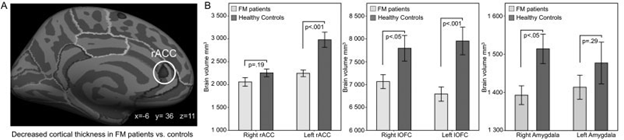
For you skeptics there’s the second, harder path. Let’s start from the premise that FM is a manifestation of a dysregulated cortisol/adrenalin factory – the HPA axis. Deep in our monkey brain is the amygdala which fuels the fight or flight adrenergic pathway, however this is a coarse control since chemical metabolism takes time. Calming electrical override is by the parasympathetic nervous system vagus nerve with help from serotonin-fired neural dopamine fueling a (hopefully) rational prefrontal cortex. Unfortunately, fibro and CFS sufferers lack this moderating instantaneous control as evidenced by reduced heartrate variability. Ashok Gupta’s solution is to re-programme the amygdala. Good luck with that, however evolving tens of thousand years isn’t a promising intervention. <Update Feb 2015: Apologies, Ashok-ji. I’d overlooked December’s report in Arthritis & Rheumatology ‘Overlapping Structural and Functional Brain Changes in Patients With Long-Term Exposure to Fibromyalgia Pain’. The amygdala changes in the right-hand diagram are associated with chronic pain causation…image002

…returning to neuroimmunopharmacology> Parasympathetic neurotransmitter Acetylcholine can inhibit inflammatory InterLeukin-6 (that alone is worth thinking about for its role in TMJD resulting from teeth grinding). Not that you’re going to meditate out of a fever, rather the need is to put the brakes on auto-immune pathways. IL-6 and IL-1 deplete Tryptophan, which we’d all prefer be used in creation of serotonin and ATP for energy but through Tumour Necrosis Factor it’s dumped. It’d be great to block TNF-α upfront through aggressive biological agents such as etanercept or adalimumab, but as rheumatologists deny FM’s suitability this won’t eventuate. Blocking IL cytokines is an even better idea, since Profs Hutchinson and Watkins showed neuropathic pain can be suppressed with naloxone – a shorter acting version of the opioid dependency treatment naltrexone. The diagram in Younger & Stringer et al article: Daily cytokine fluctuations, driven by leptin (tells the hypothalamus to get prolactin out there, but let’s not go there), puts these interactions much more clearly 😉image002
Analysis, paralysis. The neuroimmunologists and endocrinologists weaving logical arguments is messy theory, but the practice is up to your own mind. There’s so little profit to be made that pharma won’t be sponsoring studies into a quickfix pill – waiting for lowdose naltrexone proponents to capitalize on successes by Prof Younger, with approval to market seems most unwise. A mindful approach is more achievable than your cerebral cortex would think!

Mud slinging (Part 1)

Listening is a fastrack to learning. Time spent with arthritis sufferers in Moree thermal pools informed me of the benefits of medicinal marijuana after hearing how an elderly couple inadvertently spent too long in a pungent smoke filled café at Nimbin. Indeed, the largest number of reviewers at fibromyalgia-reviews.com cast an overwhelmingly endorsing vote for the weed. The side-effects preclude living a normal life, however reality has always been overrated and opt-out for many. Winfried Häuser led an investigation into evidence-based interdisciplinary guidelines across Germany, Israel and Canada but cautiously advised undertaking research by clinical trial of cannabinoids before addressing licensing. Mineral springs or balneotherapy were recommended though, an idea which was extended by researchers at the University of Pisa who compared the short-lived relief of a thermal treatment with the enduring benefit of a mudbath, in the journal of Clinical and Experimental Rheumatology.

IMG_1745Bazzichi and Lucacchini et al didn’t rely on subjective opinion of symptoms, rather going so far as to apply salivary protein analysis to differentiate an improved therapy. Justification enough for a trip to the murky sulphurous pools of Ngawha in New Zealand – their ‘Doctor’ being pictured. Not only have this team listened to their patients’ stories, but they’re cognizant of expert skepticism and the demands of evidence base. To no avail unfortunately, since founder of the Arthritis Research Centre Prof Fred Wolfe in his fmperplex.com blog derides the study as about as useful as a Chianti/Riesling comparison… “Really! Does anyone really think that mud baths are a truly useful therapy for FM? What also caught my eye was all of the ‘sophisticated’ and expensive tests that were done and what it all costs.” A cost benefit analysis requires a crystal ball for evaluating future returns from the pioneering work in proteomic salivary analysis. Thus far it’s proven useful in distinguishing Sjogren’s syndrome from other sicca syndromes such as presented by fibromites.  Relief from this discomfort of dry mouth compounded by the nuisance of a runny nose (non-allergic rhinitis) is one of the attractions of guaifenesin as a treatment, besides its neurological effects. Again lampooned on fmperplex as “Quackery”, but another unfortunate discard of babe with the dirty bathing water. Arif Donmez and team from Istanbul Dept of Medical Ecology concede that their clinical trial of a balneotherapy course, showing a diminishing improvement during 9 months of followup may have been influenced by residual benefit of a break from the daily grind. Pain was objectively measured by inflicting it with a dolorimeter however, which would have erased pleasant memories! Ouch!!

Bad medicine (Part 1)

“People have died from the drugs I have prescribed…..We Doctors have a destructive therapeutic mind set and this is causing widespread and long term harm to society “. So begins a typically thought-provoking Bad Medicine view and a discussion excerpt in the British Medical Journal, in response to the report by a forensic toxicologist that 35% of heroin overdose victims had misused gabapentin or pregabalin (editorial 15 Aug 2013). How apt are the asps of the caduceus – adopted erroneously by the medical profession in the 19th century as a result of a mistake by the US Army Medical Corps? The Hippocratic Oath began with the words “I swear by Apollo the Physician and by Asclepius …… (whose staff in mythology had only the one snake!)…. I will neither give a deadly drug to anybody if asked for it, nor will I make a suggestion to this effect”. To err is truly human, and physicians are no more exempt from blunders. The two snakes of the medical caduceus actually belong to the staff of Hermes – God of commerce and thieves, and guide to the Underworld. Hellarious!cad

The fatalities’ poisoning was associated with abuse in order to enhance euphoric effects of opioids, and GPs have been alerted to avoid iatrogenic involvement (remember do no harm!). Information is readily accessible, however overly abundant. Distilled summaries are published by the Cochrane Collaboration. Investigating any benefits of the GABA-likes gabapentin or pregabalin would reveal systematic reviews of studies by Üçeyler, Sommer and Häuser et al finding that “The amount and quality of evidence were insufficient to draw definite conclusions on the efficacy and safety of gabapentin …………. The anticonvulsant, pregabalin, demonstrated a small benefit over placebo in reducing pain and sleep problems. Pregabalin use was shown not to substantially reduce fatigue compared with placebo. Study dropout rates due to adverse events were higher with pregabalin use compared with placebo.”  Häuser co-authored an 11-year study of fibromyalgia outcomes with Dr Fred Wolfe which reported in the European Journal of Pain Sept 2012 a conclusion that “Drug costs are substantially higher because of NCAD (pregabalin, duloxetine, milnacipran) use, but we found no evidence of clinical benefit for NCAD compared with prior therapy.”(tri-cyclic anti-depressants ie amitriptyline). Confirmed by Prof Beth Smith’s meta-analysis of 51 publications in 2011 concluding “Amitriptyline was similar to duloxetine, milnacipran, and pregabalin on outcomes of pain and fatigue“. Wolfe’s colleague Dr John Quintner wrote that “a minority of patients will report substantial benefit with Lyrica… Many will have no or trivial benefit, or will discontinue the drug because of adverse events“. Which somewhat contradicts the tick of approval given by the US FDA, and it gets no better. The April 2010 Journal of the American Medical Association article ‘Anticonvulsant Medications and the Risk of Suicide, Attempted Suicide, or Violent Death’ points to an increased risk with the taking of gabapentin. Which is where we started…. and whence we shall return

Fibromyalgia breakthrough!!!

A reason for the perplexing nature of FM syndrome has been found. It’s an ophthalmic disorder afflicting the ability of the sufferer’s specialist to discern the blindingly bloody obvious. This monochrome blindness results in denial of discernable difference between pathology results for patients and healthy controls. It’s 20 years since Wolfgang Muller determined such a difference in serotonin levels between fibromyalgics (‘GTM’ on the right) and healthy controls, with less than 1 in 10,000 possibility that it arose due to chance.Muller1993

Jascko, Hepp and Sprott et al decided that “Serum serotonin levels are not useful in diagnosing fibromyalgia”, although their immunoassay showed a range of 10-115ng/ml in patients – compared to 131-322ng/ml measured in the control group. Why there’s as many fibromites prescribed serotonin boosters as are treated with anti-convulsants*, without pathology evidence confounds me. Eduardo Ortega has led many discoveries of markers such as the inflammatory Interleukin-8. Hollenberg and Blanco et al found ten times the number of mast cells in FM skin, releasing inflammatory histamines when triggered. Cordero, deMiguel and Sánchez Alcázar et al studies also show no overlap in the FM or healthy ranges of the cell fuel ‘ATP’, oxidative stressor MDA, or its peroxidation counterpart catalase between their samples of three dozen women. Although a bonus that they publish in the open-access Public Library of Science, it’s disappointing that peer-reviewed journals showing interest are the likes of the obscure ‘Mitochondrion’. Contrast this with the publicity afforded sponsorship by Eli-Lilly of Dr Frank Rice’s findings of peripheral blood vessel pathology – announced in the American Academy of Pain Medicine and lauded widely in mainstream press articles for months as a breakthrough, along with commentary which “….explains why some selective serotonin reuptake inhibitors such as Cymbalta seem to help.

Although no one test has specificity to exclude Rheumatoid Arthritis or depression, in totality there is overwhelming evidence for an exact diagnostic determination by the lab. Assuming impartiality, of course. When Dr Bruce Gillis declared “..no competing interests” in ‘Unique Immunological Patterns in Fibromyalgia’, he clearly wasn’t speaking as CEO of his company which markets the fmtest ®. Medical evidence basis demands a decision which disproves any element of chance or individual perspective. The humanities are somewhat more subjective, and in being so are also sensitive to the person. Hamlet avoids an argument by not passing judgement on a seemingly black and white issue by proclaiming “There is nothing either good or bad, but thinking makes it so… “.

*Endep & Cymbalta vs Lyrica & Neurontin

Fibromyalgia appears destined to remain the elephant in the room if this month’s Rheumatology edition of Australian Family Physician is anything to go by – not a mention of it. So what do healthcare specialists offer? In 2006 Drs Littlejohn and Guymer published, through their work as Monash Director of Rheumatology and trainee respectively “Fibromyalgia Syndrome: Which Antidepressant Drug Should We Choose”. Linking their Medical Centre with the University seems a worthy approach so as to redress physician misconceptions  – indeed, shortly thereafter the Journal of Clinical Rheumatology published a survey of Southeast Asian rheumatologists. 87% of them believed fibromyalgia incorporated aspects of psychological illness and only 40% of those associated with an institution reported inclusion of FM in their undergraduate training.

Dr Littlejohn then contributed to the 2009 yearlong study on effectiveness of duloxetine/Cymbalta led by Eli-Lilly employee Amy Chappell, which was discredited by exclusion on quality grounds from the independent Cochrane musculoskeletal group’s systematic review of studies on SNRIs . Their supposedly * impartial conclusion drawing upon another five, unbiased assessments was that 10% more people reported significantly reduced pain with duloxetine than those duped by a placebo, however another 9% discontinued treatment due to side-effects. Withdrawal in itself is harmful, the US FDA has published a safety advisory for Cymbalta Discontinuance Syndrome. Agreements posted in 32,000 blogs are somewhat alarming! Any benefits obtained are ‘figure-atively’ outweighed by weightgain reducing propensity to exercise, consensus being that moderate exercise is beneficial for fibro.

2009 was a bad year for pharma. Eli-Lilly pleaded guilty to illegal marketing of anti-psychotic drug Zalprexa for off-label use, and was fined $1.4bn. A recent out-of-court settlement was made with the family of a boy who suicided whilst on Cymbalta, whose claim being that another suicide during drug trials should have prompted warnings.  And Pfizer paid a record $2.3bn for fraudulent marketing of painkillers, including Lyrica. Nonetheless these two medications remain highly profitable with an estimated $18bn in sales in 2012…. which trivialises the settlement for $43m with US attorneys generals that year for once again marketing Lyrica other than for an approved purpose. With such monetary power, when federal NHMRC funding was approved for only 17% of applications for 2014 is it any wonder that Littlejohn and Guymer are reliant on consultancy fees paid by  Eli-Lilly and Pfizer declared (inconsistently*) under their conflicts of interest? “The medical profession—in the US, Europe, and beyond—remains heavily reliant on industry funded continual medical education, and many doctors have accepted substantial hospitality and consultancy fees. Very few have been prosecuted. Disclosure remains patchy and inconsistent. Yet it is their decisions that ultimately determine if medicines are reaching patients for whom they are not suitable. If drug companies need to change their attitude, so do prescribers“. Andrew Jack, Financial Times correspondent writing in the BMJ July 2012.

Evidence update: Two books elaborate these concerns from a practitioner’s perspective. Dr Ben Goldacre’s ‘Bad Pharma’ and leader of the Nordic Cochrane Centre, Prof Peter Gøtzsche’s ‘Deadly Medicines and Organised Crime: How Big Pharma Has Corrupted Healthcare’. Peter’s alarmist chapter title: ‘Very few patients benefit from the drugs they take’  explains that “… apart from such scientific misconduct, insufficient blinding can also make us believe that ineffective drugs are effective.” In damning the exalted gold-standard comparison – the randomised control trial, he warns of assessor bias if they’re aware to whom they gave placebo. To give weight to this claim that doctors lie, his colleague Asbjørn Hróbjartsson is cited … the effect was exaggerated by 36% when evaluated by nonblinded observers. Wow, this Cochrane review ‘Observer bias in randomised clinical trials with binary outcomes: systematic review of trials with both blinded and non-blinded outcome assessors.’ needs a read. Ooops, the title omits the keyword ‘subjective’, and 71% of the studies were surgery or the like. cochraneFigure 1 meta-analysis shows that two weighty transmyocardial laser revascularisation outcome reports by Oesterle et al and Burkhoff et al dragged the conclusion from one of no significant difference to a non-blinded bias Odds Ratio of 0.64! So, if you ask F.I.G.J.A.M. whether they THINK the patient’s angina has improved recently, there’s a leaning towards affirmation if they’re aware that surgery has been done? Cardiologists genuinely believing that their interventions are beneficial can hardly be extrapolated to mandating that all trials must be blinded in order to avoid falsification of data, but that’s what’s happened. Peter’s Mentalaz speaking tour claimed that all anti-depressants were ineffective – arguing that severe side-effects results in unblinding. And the effect size was typically <36%, whereby he proves all benefit of the med resulted from bias! And these are the watchdogs? When Cochrane’s doctors stretch the truth about the 36% shift in truth by other research doctors, they’re all damned.

 infinityCochrane pioneers Gotzsche and Chalmers are much alike in their evidence fudging. The Handbook warns  that sneaky research doctors will try to break the blind and fudge the facts. The last para of ‘Rationale for concern about bias’ cites a study by Schultz, Altman, and Sir Iain Chalmers et al in Feb 1995 JAMA. Just one review, covering studies particular to pregnancy & childbirth actually contradicts their own argument: “Trials with inadequate sequence generation yielded estimates of treatment effects that were similar to those derived from trials with adequate sequence generation, after adjusting for the other three methodological dimensions”. But on pg410 a subgroup analysis limited to those trials reporting adequate allocate concealment only managed to find a statistically insignificant p=0.07 (ie close, but no cigar) exaggeration in effect size as a result of poor sequence generation.

This cracks me up. That’s a negative outcome elsewhere than the Cochrane Collaboration, and it relied upon data dredging to obtain a semi-significant conclusion. But it underpins one of their criteria for downgrade of all studies – sanctimonious dogma used thereafter in box-ticking exercises, which actually detracts from quality analysis of evidence trustworthiness. This recalls the classical Ouroboros, the snake eating itself – as a symbol of perpetuation.
*Aust Family Physician Oct 2013: “Competing interests: None”

<Jan 2016 update: an Austrian survey found 89% of GPs would refer fibromyalgia to a rheumatologist, but only 12% of those wanted to treat the patient. With great neuro research nearby by Uçeyler, Sommer & Hauser you’d hope for more than just a handpass: http://journals.plos.org/plosone/article?id=10.1371%2Fjournal.pone.0146149 >